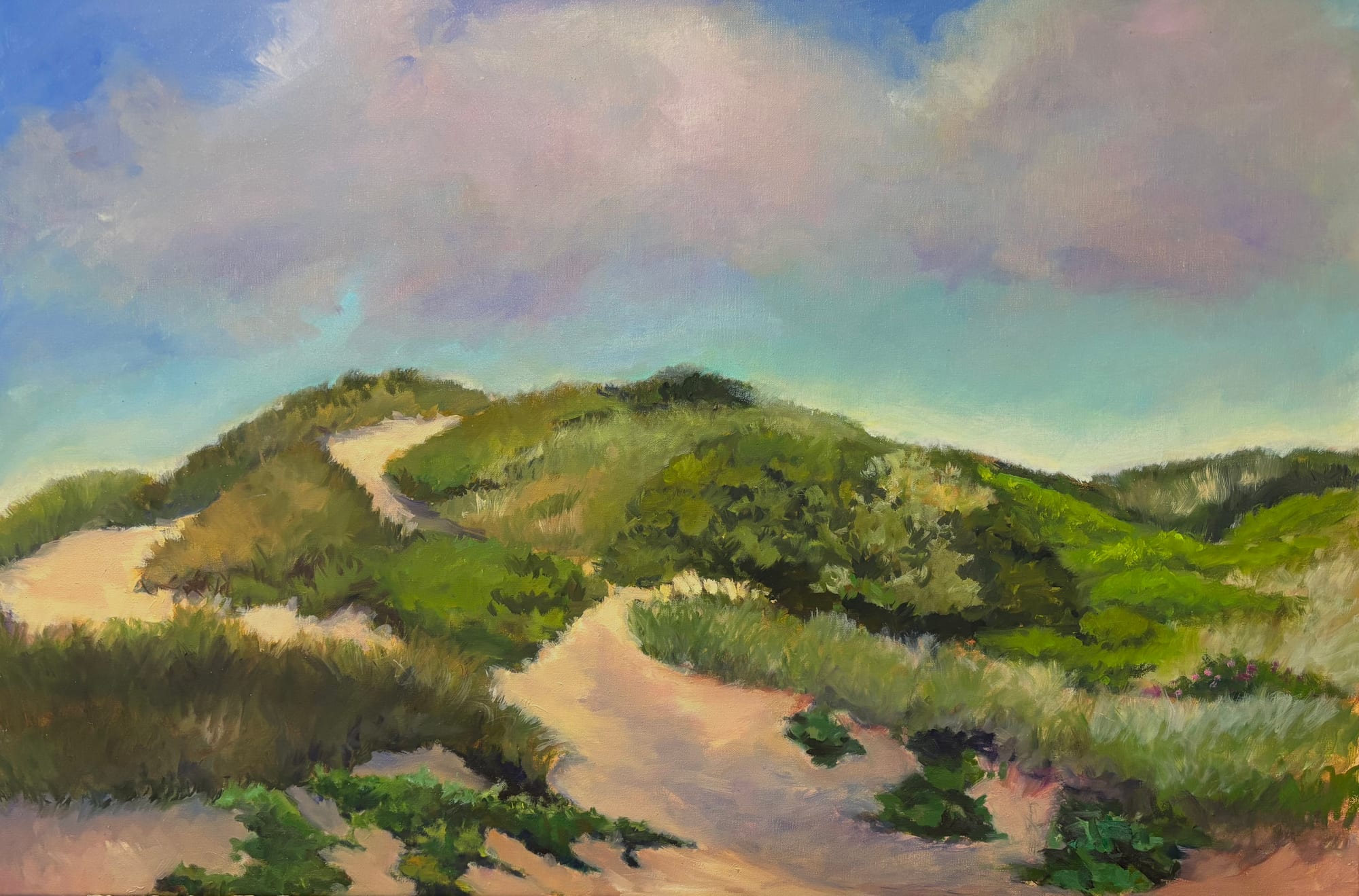
A short list of good paint beats a long list of cheap paint. Talk to Lorraine before you spend anything.
Everything here is a suggestion. You can work with more or less of it and substitute where you need to. If you already own paint, bring it and ask her about it before you replace any of it.
Paints
Golden is what she recommends. Where a line gives a second name, either one will do.
- Diarylide Yellow or Cadmium Yellow Deep
- Cadmium Yellow Medium and Cadmium Yellow Light
- Jenkins Green or Sap Green
- Dioxazine Purple
- Quinacridone Crimson and Quinacridone Magenta or Alizarin Crimson and Magenta
- Pyrrole Red and Cadmium Red Light
- Anthraquinone Blue or Ultramarine Blue
- Nickel Azo Yellow
- Cerulean Blue
- Yellow Ochre
- Titanium White (large tube)
Brushes, palette and surfaces
- Brushes: a small round, plus flats, angled or brights in small, medium and large
- A stay-wet palette. Acrylic dries fast, and this is the most useful thing you can own
- Water container and paper towels
- Canvas, board or panel in a size you can finish
Where to buy
What the class covers
Bring a work in progress or start something new. The class covers painting technique, materials and how to apply them, composition, color theory and the effects of light, at every level, with demonstrations and critiques.
Course objectives
- To understand and develop skills of constructing a painting technically and aesthetically.
- To develop visual perception using basic concepts of space, color, surface, form and content.
- To understand the physical properties of the painting medium.
- To develop a sense of visual composition.
- To develop an ability to verbalize ideas and judgments of the work.
How work is assessed
Group critique for each painting assignment, and each painting is evaluated individually.
If you are starting in oil instead, the oil materials list is the one you want. The painting classes Lorraine Skelskey-Chapin teaches in Southbury, Connecticut are listed with the schedule and where each session meets.